
-coke-boy-tibet.jpg)
-nike-girl-nepal.jpg)


MARKED
8:00 PM
/
Posted by
miss bian
/
comments (0)
5:06 PM
/
Posted by
miss bian
/
comments (0)
Received by deadline.
8:21 PM
/
Posted by
mel-
/
comments (0)
Video: Fair Trade vs. Free Trade – http://www.bigpicture.tv/videos/watch/ca46c1b95
(In relation to previous article on the cost of free trade)
Response to the video – Fair trade vs. Free Trade
After watching the video, I have a better understanding of the difference between free trade, and fair trade. I agree with Paul Rice on the advantages of fair trade, versus free trade. Through economic globalization and free trade, people in developed countries, definitely benefit from free trade. However, those in the developing world do not benefit from free trade as much. Hence the phrase – the rich gets richer and the poor gets poorer.
Fair trade conversely helps make free trade work for the poor. Fair trade does not negate the advances that free trade that made. As its name suggests, it not only incorporates the advantages of a globalized economy, but it does not leave the developing countries behind.
It is also good to know that the World Trade Organization is increasingly looking into a fairer world trading system. This way it is possible for globalization to reduce poverty rates. It is quite appalling to know that there are still people around the world who are living in poverty.
For us in Singapore, we are hardly aware of the plight of the less fortunate in third world countries. After watching the video, I better understand why fair trade should be used over free trade, and the advantages that it brings. We should try our best to help the less fortunate in any way that we can, hence being able to progress as a whole world.
9:00 AM
/
Posted by
calvin
/
comments (0)

Free trade is a system in which the trade of goods and services between or within countries flows unhindered by government-imposed restrictions. Such trade allows specialization in member states of free trade areas, and lowers costs. Within a free trade area there are no barriers, such as tariffs and quotas. These would seem as beneficial to us. But there are still some people who are against having free trade, and economic globalization. Why is this so?
• Free trade claims that it would create jobs and raise incomes, in reality, many jobs were instead lost.
o For example, in the North American Free Trade Agreement, there was a lost of 879, 280 jobs in the U.S.
• Free trade affects the environment.
o The pollution from the export of goods as well as the resource used throughout the life cycles of products, are all ways in which free trade can damage the environment.
• The plight of the developing world
o Developing nations do not enjoy similar benefits of free trade as the larger nations do. The relatively new industries of developing countries would struggle against international competition.
Are we actually paying for free trade, without knowing it? What are the costs of economic globalization? Think about it.
Bibliography
http://en.wikipedia.org/wiki/Free_trade
http://www.religion-online.org/showarticle.asp?title=255
http://www.epi.org/content.cfm/briefingpapers_bp147
http://twohandsworldshop.com/blog/tag/free-trade/
http://www.commondreams.org/views04/0108-10.htm
http://www.economicshelp.org/2007/06/advantages-and-disadvantages-of-wto.html
8:52 AM
/
Posted by
calvin
/
comments (0)
Non-Governmental Organizations: Effective?


This shall be the 3rd installment to the series Globalization and Politics. Today’s essay shall cover the rise of Non-governmental Organizations, otherwise known as NGOs. NGOs form a critical part of the globalization of politics. Why so?
Globalisation, as early as the 20th century, gave rise to the importance of NGOs. At that point in time, many around the world perceived international organizations like the United Nations or the World Trade Organization as being too centered on the interests of capitalist states. The United States of America, as well as the other 4 member states which possess veto powers, only reinforced this ideal. As such, the rise of NGOs, many political scientists believe, serves to counterbalance this trend. NGOs are mostly considered apolitical in nature, with minimal to no hidden agenda. As of today, there are 40 000 over NGOs in the world. Many of which are actively involved in humanitarian crises or 3rd world developmental schemes. Examples include the International Federation of Red Cross (IFRC).
As NGOs are apolitical in nature, many tend to be receptive to the idea of having NGOs amid a conflict to arbitrate peace talks or dialogues. Like international relief agencies, NGOs focusing on conflict resolution respond to major failures on the part of the international community to deal effectively with global problems. NGOs facilitate up to date extensive fact-finding missions, engage in dialogue with a wide range of groups involved in conflicts, map out strategies for defusing conflict and galvanise action by national governments and international organisations to help stabilise tense situations. Situations in Burundi, Northern Uganda, Southern Sudan, Darfur, DRC and Rwanda provide examples of where NGOs have played a decisive role in heading off major conflicts 1. On top of NGOs are not overwhelmed with bureaucracy which is the biggest door stop to the efficacy of the United Nations. Such international agencies and governments often have institutional and political limitations that hamper their effectiveness in situations of enormous complexity and delicacy. As such, NGOs tend to responded swiftly to any crises present. After the 6 hour all clear zone after the Sichuan Earthquake, the IFRC stepped in immediately, mobilizing humanitarian workers to provide aid and rescue efforts to the region. In 1995, it was estimated that around 14 million people were refugees and some 23 million people were internally displaced. This provided fertile grounds for the rise of NGO activities in this area. In most cases, NGOs responded more effectively to these crises as the international organizations and states grapple with the issue of humanitarian intervention. Their operations have helped changed lives during and after conflicts 2.
In a nutshell, NGOs are perhaps the most sought after organizations in the world due to this efficiency in handling conflicts and humanitarian crises. It’s apolitical nature with no hidden agenda, allows it to enjoy great public support, with numerous people advocating their various causes. Hence, it’s not surprising how NGOs are able to have a steady source of funding for their humanitarian missions.

BIBLIOGRAPHY
http://cache.daylife.com/imageserve/0ana8YL377goP/610x.jpg
IFRC Picture
http://upload.wikimedia.org/wikipedia/commons/thumb/b/b7/Flag_of_the_IFRC.svg/800px-Flag_of_the_IFRC.svg.png
NGO picture
http://www.gambianow.com/news/files/ngo.jpg
1. NDUNG’U WAINAINA. 2006. Role of NGOs in Conflict Prevention Control. [online] United States of America. Global Policy Forum. Available at:
2. BEN OFOSU-APPIAH. 2008. Making NGO’s more effective and Responsive in a Globalized World. [online] United States of America. Global Policy Forum. Available at: http://www.globalpolicy.org/ngos/intro/growing/2008/0328ngoglob.htm. [Accessed: 09 August 2008] Labels: zengan
8:47 AM
/
Posted by
calvin
/
comments (0)

One of most visible sign of the globalization of politics is evident in the establishment of the United Nations. The United Nations is an international organization that aims to ensure collective peace and security, providing assistance to humanitarian crises in the world. In the short history of the UN, some have argued that the UN has failed in its duty to uphold its intended objectives and aims. Also, some argue how the UN is filled with so much bureaucracy that undermines its effectiveness as an international body.
The most poignant example of UN’s failure to achieve its intended objectives and aims would nevertheless be the Rwandan genocide. Till today, it remains the stark reminder of the need for prompt and decisive international intervention. When the killings began on 6 April 1994 , the UN deployed peacekeeping troops to preserve peace and security. Later in light of the escalating violence, the UN Security Council voted unanimously to withdraw their peacekeeping troops. In a just a few days, thousands of Tutsis had been murdered. Yet throughout the carnage, the UN studiously refrained from labeling the mass killings as Genocide. Had the term been used, the UN would have been legally obliged to intervene, according to Article 1 of the convention on the prevention and punishment of genocide , which was adopted by UN. This is a prime example to demonstrate how UN has failed in achieving her intended aims.
Also, the UN suffers from a bloated bureaucracy, in which seniority is not linked to ability, resulting in painfully slow decision-making and operational failure in such crises as Rwanda and the former Yugoslavia. Some UN organisations, such as UNESCO have been viewed as so corrupt, countries such as the USA and the UK have withdrawn from them , while the US Congress has long withheld part of the dues it owes to the UN in protest against corruption and money-wasting.
There are also institutional problems associated with the General Assembly and the Security Council, whereby GA resolutions with widespread support can be stymied by a single veto from one of the Permanent 5 . This has led to unilateral action by countries such as the USA and organisations such as NATO, undermining the authority of the UN, and to a lack of credibility for the UN in dealing with issues such as Israel and Palestine, where the USA among the P5 has strong interests. For example, in the United States of America, the establishment of the Clinton doctrine allows US to forcefully intervene to prevent human rights abuses, with or without the authority of the UN Security Council.
In a nutshell, the UN has shown itself to be a “tired” organization – worn-out from all its institutional problems and bloated bureaucracy. Indeed, the UN has been inefficient in the past, evident in operational failures in Bosnia and Rwanda. However, our saving grace is to know that UN’s actions are evolutionary. UN has succeeded in Kosovo in 2001, ending genocide swiftly, despite failing in 1994.
BIBLIOGRAPHY
Picture
http://www.dfait-maeci.gc.ca/canada-magazine/issue16/site/images/refugees.jpg
http://www.un.org/esa/socdev/unpfii/media/images/UN-LOGO%20copy.jpg
Mark Doyle. 2004. BBC News Online, United kingdom. BBC. Available at: http://news.bbc.co.uk/1/hi/world/africa/1288230.stm. Date Accessed: 2nd August 2008
United Nations 1948. Convention on the Prevention and Punishment of the Crime of Genocide. [Online]. University of Minnesota. Available at: http://www1.umn.edu/humanrts/instree/x1cppcg.htm. Date Accessed: 2nd August 2008
UN Chronicle. 1984. United States informs UNESCO of intent to withdraw - United Nations Educational, Scientific and Cultural Organization. [Online]. United States of America. Available at: http://findarticles.com/p/articles/mi_m1309/is_v21/ai_3117890. Date accessed: 2nd August 2008
Wikipedia Admin. 2008. United Nations Security Council veto power. [Online] United States of America. Wikipedia. Available at: http://en.wikipedia.org/wiki/United_Nations_Security_Council_veto_power. Date accessed: 2nd August 2008
Charles Krauthammer. 1999. Clinton Doctrine [Online]. United States of America. CNN.com. Available at: http://www.cnn.com/ALLPOLITICS/time/1999/03/29/doctrine.html. Date Accessed: 2nd August 2008 Labels: zengan
4:07 AM
/
Posted by
calvin
/
comments (0)

http://www.internetworldstats.com/stats.htm
With the globalization of technology, the number of internet users is on the rise. Looking at the image below, you would get a general sense of how the statistics of internet users is receiving an upwards trend. The circled columns show the stark increase from 2000 to 2008.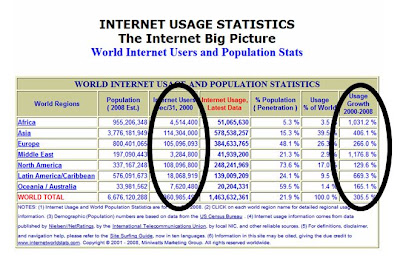
(Click on image for clearer view)
Technology has caught on with many and has become an integral part of the lives of many. Are you one who can survive without technology? Vote now, and share your views on this issue (click the comment button!)
3:56 AM
/
Posted by
calvin
/
comments (0)
Imagine this: you want to ask your friends out to go for dinner and a movie. Because cell phones have not been invented, you have to walk 5 kilometer to your friend’s house, ask him or her if they wanted to go with you, walk another 5 kilometer to ask another friend, and another 10 more kilometers to get back home and change.
http://www.illustrationsof.com/images/clipart/xsmall2/8890_sweaty_fat_man_running_and_trying_to_keep_up_with_a_snail.jpg
That was the Stone Age where nobody owned hand phones and communication was obviously a tedious process.
Fast forward to the 1900s where the first, two way radios were invented (they were known as mobile rigs). They were installed only in some vehicles such as ambulances and police cars. In 1940s Motorola came up with the first walkie talkie. This was a widely popular form of communication but of course, it could only be used when two people were within a certain distance from each other.
http://www.usarmysignalcorps.com/bc611%20tag2.jpg
“First Walkie talkie “
Now, in the year 2008, cell phones usage is raging. Cell phones now come with functions that blow the mind of many, touch screen phones, cameras that boost the same number of mega-pixels as digital cameras, phones that allow you to surf the internet anywhere anytime, phones that play music. The list is never-ending. No wonder so many people have caught on the craze of cell phones. Cell phones are no long just used for sending each others SMSes or just calling your friends to ask how to do a math question. Cell phones are now music players, cameras and many more jumbled into one.
http://images.pcworld.com/reviews/graphics/118242-2212p074-9b.jpg
These are some statistics that show how technology has globalized.
• In the world, there are more than 2.4 billion cell phone users
• More than 1000 new customers are added every minute
• Mobile phone shipments grew 19 percent to 810 million units in 2005 and are expected to rise by 15 percent to 930 million units
• Cell phone usage in Africa is growing almost twice as fast as any other region and jumped from 63 million users two years ago to 152 million today.
(Taken from: http://www.revivaltimes.com/cellphonestats.html)

Kindly click on the crossword puzzle for a clearer image! Thank you!
6:34 AM
/
Posted by
calvin
/
comments (1)
 Credits to: American Idol, Microsoft Office, American Express, Apple, Converse, Levis, Starbucks, Mariah Carey, Mercedes Benz, Louis Vuitton, Mcdonald's, Nokia, Mario, Marlboro, Chanel, DKNY, Disney
Think about these...
How does globalization affect the languages we speak today? How does it affect the way we dress? The music we listen to? The trends we follow? How did 'emo' come about? What kind of shows do you watch on tv? Where's the origin of your favorite music/art/drama? Has globalization made us more proud of our ethnicity? Is globalization good, or bad?
Kindly leave your opinions in the comment box! :-) Labels: louise
6:08 AM
/
Posted by
calvin
/
comments (0)
It is the December holidays. You decide to visit China to have a fulfilling experience of Chinese culture. You land in Shanghai and decide to stay for ten days. Soon you get bored of the usual porridge and duck meat. A mcdonald’s restaurant is right outside the hotel. Day Five. You flew over to Beijing. After much walking along the Great Wall of China, you felt thirsty. Had too much chrysanthemum tea? How about Starbucks? It’s right at the corner! Day Seven. You decide to go shopping. There are aplenty shopping malls in the city! However, you walk into the mall and you see Louis Vuittion, Prada, Gucci stores. Just like your Paragon back in Singapore. Day Eight…………


http://samgreenfield.com/log/labels/China.html
http://www.destination360.com/asia/china/great-wall-of-china.php
At the end of the trip, do you dare to say you fully experienced the Chinese culture?
This is globalization. Today, countries no longer possess their own culture. It is infiltrated by cultures belonging to other countries. Giant brands such as Mcdonald’s, Louis Vuitton and Gucci can be found in all regions of the world. This is globalization. Sameness. A common global identity. Loss of culture. This, is globalization.
Globalization = The world becoming Americanized?
If you notice, most of the brands that exist all over the world are American. Various devices of mass communication, such as internet and films, have caused the American culture to spread all over the world. It is dangerous, as soon the world would grow fond of the American culture and that would lead to a loss in many countries’ original culture.
The Power of Globalization
is not to be underestimated. It is a phenomenon that no one can escape. It is affecting the language we speak, our religion, the clothes we wear, the programs we watch, the music we listen to, and many more. Being the main control of globalization, media is all around us. It is impossible to not be affected by globalization as media is involved with almost every activity in our daily lives.
It all boils down to technology!
Technology is the main mediator of globalization. Without technology, there would be no devices such as the internet and television which overcomes the barrier of distance and introduces foreign culture into our lives. Eventually, people from all over the world would be living and dressing the same way, eating the same type of food and talking in one common language.
4:32 AM
/
Posted by
calvin
/
comments (0)
http://www.youtube.com/watch?v=ICiEt-u9Kbw
The video raises several key issues, like the increased use of technology in our lives, the spread of the english language, and the continued inventions of super computers. All these are signs of a change in times, the spread of globalization.
Globalization has hit almost every country in the world. Whether big or small. In the video, the figures show that an astounding number of people use the search engine google, log online to MSN or use the networking website myspace, every single day. Its shocking how from a world where instant messaging was only possible in dreams, to a world where instant messaging is common in any household. The use of the internet and the world wide web had increased so much so that almost every family in any modern day country has access to the web. The internet has become so important to people that it has been discovered that some families cannot bear to not use the internet for even one day!
Another example of globalization would be the use of the English language. Since the early days of shakespeare, the number of words in the english language has increased by 5 times. It has been estimated that even China will soon be the country with the most number of english speaking people. Its a cultural shock to see the traditions and cultures of the past being forgotten, to make way for the modern day era.
Globalization has hit, it is changing the world we are living today. We must be prepared to face the consequences it brings, the lost of culture, the dependance on technology, etc.
Labels: calvin
Is globalization beneficial to us? Or is it eliminating the few links we have to our traditional cultures and beliefs?
“Globalization is not something we can hold off or turn off . . . it is the economic equivalent of a force of nature -- like wind or water.” – Bill Clinton.
In 2006, according to the Globalization Index, Singapore was rated the country most affected by globalization. All over we see Mc Donald fast food centers, Starbucks coffee, and Apple Ipod Stores pooping out all over our country. Not only is this happening in Singapore, it is happening all over the country too. In the slideshow of pictures, you can see the many different locations of Mc Donald and Starbucks outlets. Ranging from Bali, to Russia, to even Thailand! Globalization of culture has hit almost every country in the world, big or small.
Globalization can be both beneficial, yet harmful at the same time. Globalization encourages the growth of new cultures, the invention of new technology, and the spread of creative ideologies. Who are we to stop this progress? Globalization has caused the rise of technology that man is so dependant on these. The internet, Google, music players, laptops and desktop PCs are just a few examples of the most widespread of technologies in our world. The use of internet has enabled people from all over the country to interact with one another so much more efficiently. Gone are the days where overseas pen pals have to wait for weeks to receive a reply from their friends overseas. Now with a few press of the keyboard, and the click of a mouse, you can expect an instant reply from your foreign friends.
The rise of video sharing websites like YouTube, and search engines like Google, has created an open portal for internet users to learn about other cultures and beliefs all over the world. People can discover many things about their foreign neighbors through a quick search on Google; there are a 1.2 billion searches made on Google every month.
Globalization has given people so many benefits that it’s hard to reject it. The people, who argue against globalization, are fighting a losing battle. Trying to deny it is like trying to deny the rise of the sun every morning. Globalization is part and parcel of our life, it may bring about benefits or harm, but we still must accept it. But for now, globalization is something worth celebrating.
Subscribe to:
Posts (Atom)